Note: This is the first part in a series of posts that will appear over the next few weeks attempting to answer the question, “Can hobby beekeeping be financially successful?” This will be a “middle of the road” scenario. It could be done more cheaply than this and I will point out ways that can be done as we go along. There could also be legitimately higher cost that are unique to an individual, set of needs, or location. For simplicity, time is not included. The activity plan in this post would also make a handy checklist to print out and follow through your first year to make sure you’re keeping your beekeeping up to date.
I did this once before.
About 25 years ago I put pencil to paper and laid out a plan for growing a financially successful commercial beekeeping business. I projected expense and income for the first several years, taking into account all the factors I could think of. I projected that at the end of the first year I would have a certain amount of colonies and a certain amount of profit and by the end of the second I would be even further along. And—I don’t remember anymore what the master plan would come to be in the next several years, but I was going to make a certain amount of money in a certain amount of time.

It didn’t happen like the paper said it would. The learning curve was about straight up. That was in the early years of neonicotinoids, and I lost 50% of my bees each year for the first three years. Not financially successful.
Well, they say that the definition of insanity is to do the same thing over and over and expect different results. Here, I’m going to project income, expense, and profit again in the next several posts. Hopefully I’m not insane and the results will be different for you. Experience has tempered my numbers, and so maybe I’m not doing the same thing after all.
I would like to present a picture of what newbie beekeeping could look like financially. Can a newbie make any money? Or is hobby beekeeping always going to be a fun, therapeutic, beneficial-in-other-ways, money-pit activity like most hobbies? Let’s examine it.
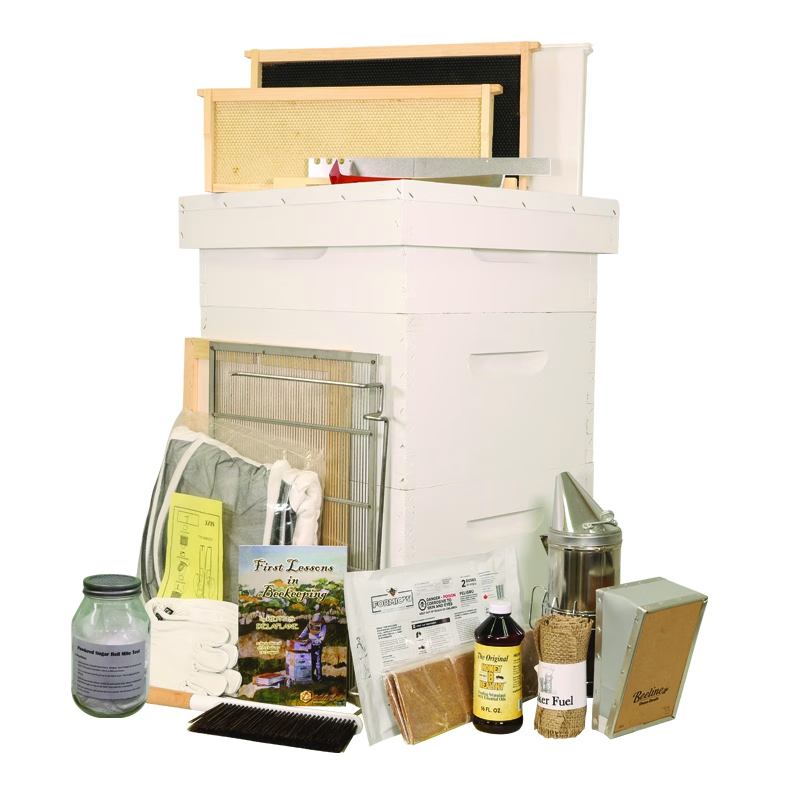
Here are the basic parameters. We are going to start with two hive setups and two nucs at the end of April. We are going to run double deeps with 10 frame equipment and we going to keep it to the essentials. No frills.
We are going to use a mite treatment regimen that will pretty well guarantee control even if we fail to do all the recommended mite checks. We are going to be doing something with the hives once every week during the month of May and then every two weeks at minimum thereafter. We are going to feed heavily during all non-flow periods to keep the brood rearing strong. We are not going to make honey production a priority but we are going to super adequately so that if they can make honey they will not become honey bound. We will take all the honey we can at the end of the honey flow and begin feeding heavily and immediately. We will not be making any splits this first year. We will make learning the number one project—learning to find the queen, learning to manage for health and strength, learning to spot problems and deal with them, etc., etc., etc. We aren’t going to try anything fancy the first year.
The location for this project is southern Michigan about 41st latitude. The procedure will vary somewhat in other locations.
The activity plan will look like this:
March—attend a bee school, read some books, watch some good videos, talk to some old-timers, and go to a conference. Find a good supplier for nucs, and order 2 of them.
Before the nucs arrive—set up two hives in an ideal spot. Just the bottom board, 1 deep, inner cover, and telescoping lid.
End of April, beginning of May—install the two nucs, treat with SuperDFM, and feed with a half-gallon of light syrup immediately.
Within 7 days— later check for eggs. If no eggs, contact the nuc supplier for a replacement. Feed another half gallon of light syrup.
Mid May—Check hives for growth and health. Feed a half gallon of light syrup. Move an undrawn frame inside a drawn frame to hasten growth.
One week later—Check again and move another undrawn frame inward. Feed another half gallon.
Last week of May—Check again and repeat frame movement. By this time the first deep should be pretty full and might require the second box. Usually by this time feeding can stop. Treat with 1 strip of Formic Pro.
First week of June—Check again. Most likely the first deep will be 75% full and the second deep should be added. Move two frames of brood and bees from the bottom box up to the second box and replace them with undrawn frames. Leave the Formic Pro strip in place and place two strips of VarroxSan across the top bars of the bottom box. Also treat with SuperDFM.
At least two weeks later—check again and perform frame switching to promote growth. Check brood and perform remedial action if problems are evident. If not queenrite, get a new queen immediately.
Checking oftener than every two weeks will give opportunity to manage for faster buildup but these checks should not be invasive.
End of June—If all has gone well and there is an obvious honey flow, a honey super can be added. Treat with SuperDFM.
One week later—especially if honey flow is heavy, open lid to see if extra room is needed. If super is 75% full, add another super.
Mid July—do a light inspection to determine honeyflow, queenriteness, and overall health. This does not need to be a full hive inspection.
Mid to end of July—Determine when honey flow is over and pull all the honey that can be pulled. The only honey that should be left will be what is in frames containing brood and/or pollen. Do an intensive hive inspection looking for queenlessness, disease, spotty brood pattern, small hive beetle infestation, etc. Make management corrections immediately. Perform a mite roll and treat if mite count is high. If queen is poor, requeen (last chance for season). Feed a gallon of syrup immediately. Extract honey and enjoy.
One week later—Feed a gallon of light syrup. Repeat religiously at 1-week intervals. If brood chamber seems too full, add a super or a deep of undrawn comb. You can’t overfeed a bee. This is a good time to draw comb for next year. Treat with SuperDFM (beginning of August).
End of August—(as early as temperature allows) Do a light inspection for brood pattern and overall health. Treat with two strips of Formic Pro. Feed a gallon of light syrup.
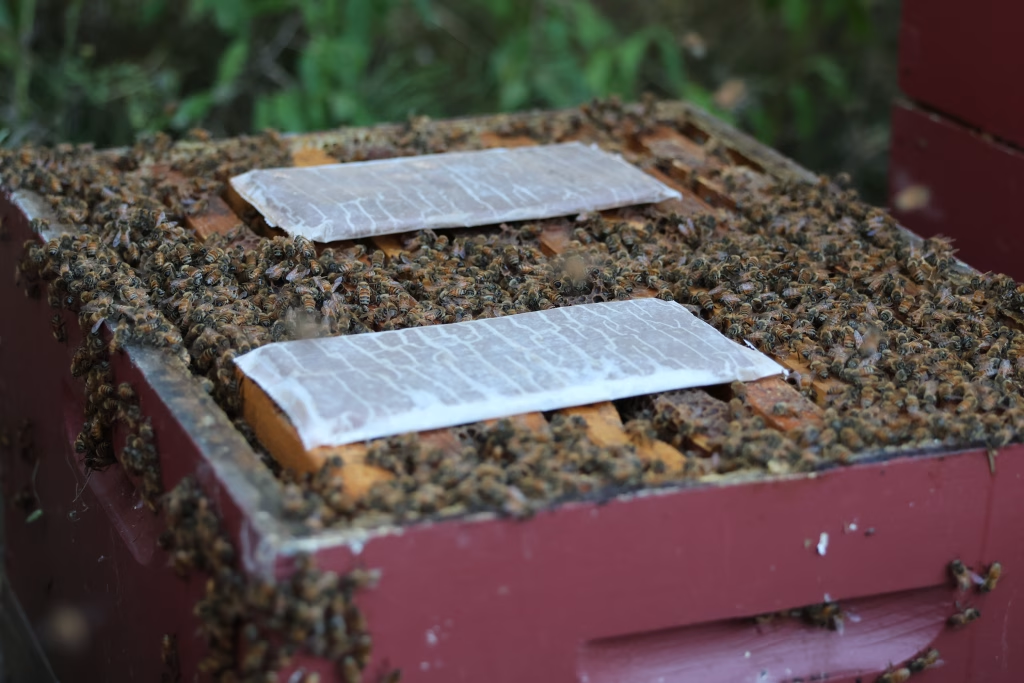
Beginning of September—Treat with SuperDFM.
Through September religiously feed 1 gallon of light syrup every week. DO NOT skip these feedings under any circumstance. A pollen patty can be given occasionally to boost brood production.
Beginning of October—Treat with SuperDFM.
Through October religiously feed 1 gallon of heavy syrup every week. Again, DO NOT skip these feedings under any circumstance.
Last warm day of the season (watch the weather forecast)— Reduce hives to two deeps as much as possible. Lightly inspect hive for queenriteness, brood, feed, and cluster size. It is very difficult to do any remedial work now except to put on fondant or sugar bricks if feed is not enough. Syrup feeding stops. This inspection informs us of how well we did our job for the season and what the overwintering prospects are.
Sometime around Thanksgiving—treat with an oxalic vapor treatment.
Hives should be checked for feed at least once a month during January, February, and March. Place fondant patty or sugar brick over cluster if they have “chimneyed” to the top.
This procedure should give optimal survival and the greatest likelihood for financial success. I’ll run the financial numbers for the year based on this procedure in the next post.
-Jonathan Showalter | Beeline of Michigan

Product Pricing
Our products are priced for material, labor, overhead, and profitability. On our website, all product prices include a percentage to cover shipping costs in order to provide “free shipping” on most orders over $150. In our catalog, we do not bury the shipping expense in our product prices, and shipping costs are passed on in addition to the product costs. Due to fluctuating raw material costs, prices are subject to change without notice.
Payment Methods and Terms
Online checkouts accept all major credit cards through Stripe. A printable order form is also available. For mail-in or phone orders we accept US currency cash, money order, checks drawn from a US bank, or Visa, MasterCard, Discover, and American Express cards. Please make checks payable to “Beeline.”
PRINTABLE ORDER FORM LINK
For mail-in and phone orders up to $500, we expect full payment before shipping. Over $500 we require 50% down payment before shipping, with the balance due within 30 days of the invoice date. After 30 days from the invoice date, the bill will be subject to a finance charge of 1.5% per month.
A fee of $25 will be charged for returned checks.
If an overpayment was made, we can either refund you or credit your account.
State Sales Tax
We are required to collect sales tax in the states of Michigan, Pennsylvania, South Dakota and Washington. If you are exempt from sales tax, we are required to file a signed tax exemption certificate. Please call or email us for that form.
Turn Around Time
Orders will be processed as quickly as possible. We will try our best to fulfill online orders within 2 business days and will notify you of any delays. Orders received after 12 noon will not be processed until the following business day. Skid-sized orders over 200 pounds may require up to a week or more, especially at peak season, which is generally January through June. Order early to ensure timely delivery.
Backorders
If your order contains out-of-stock items, we will contact you by phone or email with several options. We can ship your order without the backordered item and send the backordered item(s) separately, with additional shipping and handling charges. We can hold your order until the backordered product is available. Or you may choose to cancel that part of your order. We also have the option of filling your order in part or entirely from one of our other branches.
Limitations / Liabilities
We will be liable only for the purchase price which customers have paid for an item. We do not offer warranties, either expressed or implied, for products which we do not manufacture. Customer purchases glassware and wax foundation at their own risk. We cannot offer refunds on or exchanges for the following; Beeswax Foundation, Medication, Containers and Glassware or Bee Food. See shipping policy for further information for damaged and returned items.
Publishing Errors
We reserve the right to correct or adjust any price or product due to photographical or typographical errors.
Shipping Range
We ship online orders to all 50 states of the USA from the appropriate branch. Canadian customers may place orders by phone or email. We do not ship outside of the USA and Canada.
Free Shipping
On our website only, Free Shipping applies to most orders over $150 to the USA.
Pick Up Orders
Orders can be picked up at the nearest branch within store hours or by appointment. All orders picked up at a Beeline Branch receive a 10% discount from the website prices.
Michigan
Monday through Friday, 8:00 A.M. to 12:00 PM and 1:00 PM to 5:00 P.M., EDT. We are closed for most major holidays.
Address: 20960 M-60, Mendon, MI 49072
Email: sales@beelinewoodenware.com
Phone: 269-496-7001
Washington
Monday through Friday, 8:00 A.M. to 5:00 P.M., PDT, Saturday pickup by appointment only. Hours are subject to change August through December. We are closed for most major holidays.
Address: 19019 Moon Road SW, Rochester, WA 98579
Email: beelineofwa@norcell.us
Phone: 360-280-5274
Shipping Charges
For online orders, all shipping costs are covered with product costs, providing “free shipping” for most orders over $150. For all orders under $150, and for all phone and mail-in orders, shipping and handling will be calculated and charged at checkout based on weight and zone from our nearest branch.
For pallet-sized orders placed by phone, email or mail, all freight costs will be calculated with LTL carriers, either directly with the LTL carrier or through an LTL broker, to find the best price. Miscellaneous additional shipping charges may occur for the following reasons:
Shipping Estimates
When providing a shipping estimate for small or large orders, we will do our best to accurately calculate. However, in some situations, the shipping costs can change. If the cost increases significantly from the cost you were originally quoted for the same product, we will contact you before shipping.
We accept returns on eligible items within 30 days of the original order date. All returns must be approved in advance—please contact the branch from which your order was shipped for verification. Returned items must be unused and in the same condition as when purchased. Products must be returned to the original branch and must include the invoice number. Return shipping must be arranged through FedEx or UPS or delivered to your local branch.
For merchandise returned due to a change of mind, customer error in ordering, or no longer being needed, the return shipping cost is the customer’s responsibility. For replacements involving damaged items or shipping errors, Beeline will cover the return shipping costs.
Please note: No returns or exchanges are accepted on Beeswax Foundation, Medication, Containers, Glassware, or Bee Food.
All products shipped from our facilities are shipped F.O.B. and become the customer’s responsibility upon shipment.
Missing Parts
With the best of efforts in our stock-picking, we can still miss parts. Please check all orders immediately. If something is missing, contact us within 10 days of the invoice date or we cannot be responsible for errors or discrepancies.

Call or email the branch nearest you to determine location eligibility. Visit our Locate a Dealer page to view a map of current Beeline dealers. If you are outside of 60 or 80 miles of an existing, protected Beeline dealer, you are likely eligible. Your nearest branch will be able to tell you if your nearest Beeline dealer is protected or not. If you are eligible, read our policy here thoroughly before deciding which level you would like to enter. Once decided, fill out the application form found in the policy document, and submit to your nearest branch. As soon as they accept your application, you are free to place your initial order. The total of this initial order will determine which level you are entering, and which discounts you receive.
To maintain your level, your total invoiced sales within 12 months (or if you have begun mid-season, we extrapolate your total based on your total sales in that time period) must exceed the Annual Total in the chart above. To move to the next higher level, your total invoiced sales to date must exceed the Annual Total of the higher level. For example, if you are a Worker Level Dealer, and wish to become a Queen Level Dealer, your total invoiced sales to date must exceed $30,000, to become a Queen dealer. This can happen anytime within the 12-month period.
Not able to reach the Drone Level, but still want to buy and resell? Sure! We will give you quantity pricing and you can resell as much as you want!
Please remember, all dealer discounts are taken off our low-volume pricing. Catalog quantities and discounts are disregarded. This pricing is usually the same as our catalog pricing, unless prices have changed mid-year.
Every year on November 1st, we will assess your dealership level, based on your total invoiced sales to date, and determine which level you will be in for the next year.
Read about pricing, advertising, production, shipping, placing orders, and dealership perks in our policy here.
We also strongly recommend associations, clubs, bee schools, etc. to pool their order for a “dealership” status. A primary objective of our dealership network is to cut shipping costs for the end customer, so any of these “dealership” methods helps everyone. Can you or someone you know fill a spot in our Dealership Map?