No products in the cart.
Note: This is the fifth part in a series of posts attempting to answer the question, “Can hobby beekeeping be financially successful?” It covers the activity plan for year three. Be sure to go back and read the March 6th, 11th, 25th, and April 3rd posts before digesting this one. You can look forward to at least two more posts in this series.
The plan of activity for the third year will look much like the plan for year two, so some descriptions will be abreviated. Be sure to refer back to previous posts in this series for more details. Like the second year, we will plan to sell any July splits in the fall that we do not want to keep. Not the best idea for saleability but it avoids needing to by extra wooden equipment for overwintering.
We went into the winter with three colonies. We will assume that one died and have two left to work with for the new season. One will be quite strong and will allow us to pull a split off of it in May. The other one may be weaker and make a good summer colony but will not be strong enough to pull a full split from but we will still pull the queen out with a frame of brood and furnish a second brood frame from the strong hive. Of course if all came through strong we would have a lot more potential for profitability in the third year but we need to keep this realistic. We will not need to buy a nuc this year. The goal would be to now run a self-sustaining operation from now on and never need to buy another nuc. Keep in mind that this requires much vigilance in mite control and feeding. We will also need to make splitting a routine part of the program.
Here’s the plan:
January—Apply fondant paddies or sugar bricks as needed.
February—Apply fondant paddies or sugar bricks as needed.
March—Apply fondant paddies or sugar bricks as needed. Apply pollen substitute when appropriate.
Toward the end of March—First hive inspection.
Beginning of April—Start feeding light syrup. Treat with SuperDFM.
April and early May—Every week or two add pollen substitute and feed light syrup. Treat with SuperDFM at the end of May.
Mid-May—Assuming that we come through the winter with 66% survival, we now have two hives to work with. Our objective for this series is to maintain at least two colonies at the beginning of the season which we will define as mid-May. Our survival rate of 66% makes that possible. We will make spring splits off of these to mitigate swarming. Colonies will tend to swarm anyway. It’s better to control it by splitting and keep the bees in our possession than to let them swarm and lose the bees to the trees. This will also increase our summer potential and set things on course for much better chance of survival for the coming winter.
So, in mid-May we will find the queens in each of the colonies and place the frame with her, brood, and bees on it into a Jester EZ nuc. Find another frame of young brood and nurse bees for the nuc along with a frame of resources. It is reasonable to assume that we will make at least two nucs off these two overwintered colonies although we might need to complete the one nuc with a frame of brood from the strongest of the two. Use the OTS queen rearing procedure that we used last July on the parent colonies. (Break down cells to encourage queen production) Unlike last July, we will let the nucs we make in the same yard. The field bees will fly back to the parent colony and the nurse bees and new hatch will keep the nuc going. Feed all colonies with appropriate amounts of light syrup.
A week later—Feed split nucs. Go through the parent colonies on which the first step of OTS queen rearing procedure was performed and make sure there are queen cells. If all has gone well we will have these two parent colonies (that are making new queens) and two split colonies (with the overwintered queens) to go into the summer. The parent colonies have the potential of 70 pounds of honey each and the splits 30 pounds. We will use these numbers for our honey crop figures in July. All four colonies have the potential of at least two splits but in case something happens to one of them, we’ll calculate our financials with three splitable colonies in July. We will buy one more 10 frame hive setup and a deep kit for the additional split that we just made. If
only two colonies as our baseline number this would be the last woodenware we need to buy (giving us four double deep setups).
Last week of May—Stop feeding parent colonies and add the first honey super but do not check for a queen yet. Treat split nucs with one strip of Formic Pro each and feed.
First Week of June—Check all hives and treat with SuperDFM. Add supers to parent colonies if needed. Put appropriate number of VarroxSan strips on all colonies. Feed split nucs again.
One month after splits were made—Check for queen in parent colonies. If requeening was unsuccessful, perform remedial operations immediately.
Throughout June— check all hives at least every two weeks. Add supers if necessary. Transfer split nucs to 10-frame wooden equipment when necessary. Continue to feed split nucs as necessary.
End of June—Treat all colonies with SuperDFM. Add space where necessary. On parent colonies add supers. On split nucs, add a second deep. This might wait till July.
Mid July—do a light inspection to determine honey flow, queenriteness, and overall health. Add space, manipulate frames, and perform remedial operations as needed. Feed split nucs if necessary.
Mid to end of July—Pull honey as soon as the honey flow is over. Extract.
As soon after pulling honey as possible—Do an extensive inspection, perfom remedial work on disease and mite issues, and requeen poor colonies. We will assume three are good to split and out of those three we can harvest six nucs. We will follow the OTS queen rearing and splitting procedure that we used in the first year—kill all queens, break down cells to optimize queen production, and pull of as many splits as possible one week later. Consequently, we will now have nine colonies—three parents and six splits. Take those splits at least two miles away (better three). Feed immediately.
Beginning of August— treat all colonies with SuperDFM.
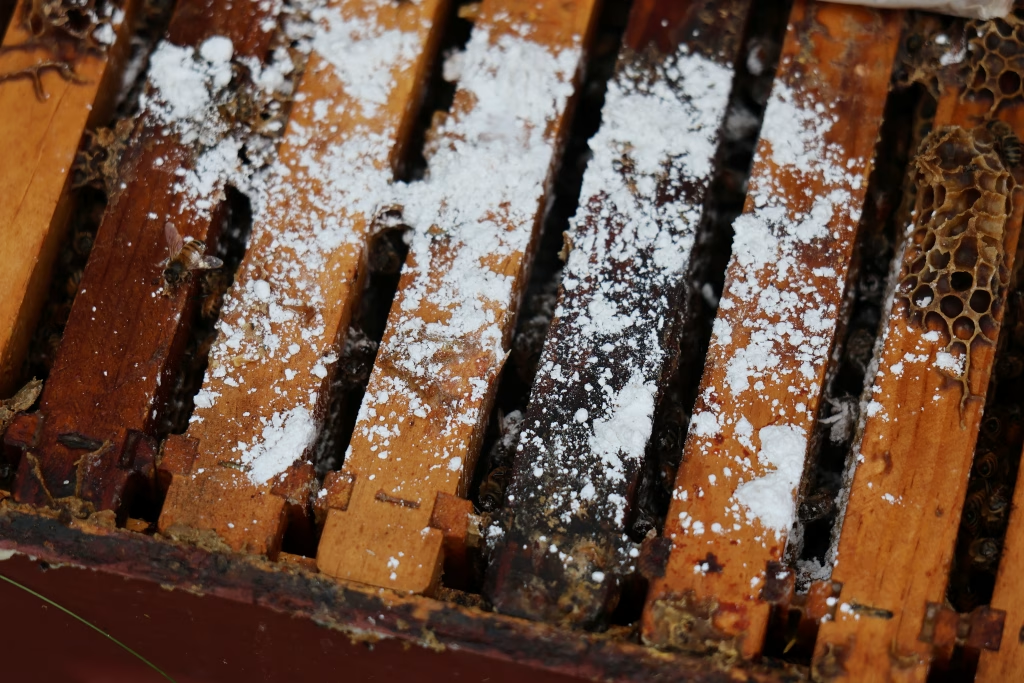
Throughout August—Feed all colonies at least once a week with light syrup. One gallon per parent colonies and half gallon for splits. Increase amount as splits grow. Remember, you can’t overfeed a bee. Check all hives for mated queen about a month after split was made. Perform remedial work with the unsuccessful splits. Treat any colony in which queen was not killed (if decision was made to leave her alive) with appropriate amounts Formic Pro.
Beginning of September—Treat all colonies with SuperDFM. Continue feeding religiously.
Through September— Find a buyer for the July splits. For our calculations we will assume that 5 splits out of the 6 are saleable. When preparing nucs to sell, we should find them strong enough to pull a frame of brood out and add those frames to the colonies we will be overwintering. Keep in mind, though, that a buyer at this time of the year will not be satisfied with just two frames of brood and bees as they would have been in the spring. Again, it might be best to put all the splits through the winter and sell less for more in the spring, however, that will require buying more 10-frame hive setups. Do not try to overwinter in JesterEZ nuc boxes.
Mid September—Treat all colonies in which queen was killed with appropriate amount of Formic Pro.
Throughout September—Continue to feed heavily.
Beginning of October—Treat all colonies with SuperDFM.
Throughout October—Feed heavily with heavy syrup.
Last warm day in the season—Final inspection, unit small colonies with larger ones, put sugar bricks on if feed is not sufficient, winterize.
Around Thanksgiving—Treat colonies with oxalic vapor or dripple.
As before, check hives periodically through January to March and feed with fondant or sugar bricks if needed.
As with the second year, the above plan was figuring for three colonies going into the winter and selling all the nucs we made in July. If we want to mitigate more overwintering risk, we can keep more of the splits and sell in the spring. It might take more
equipment and make it feel like a bigger operation than the “two” colony baseline that we have set for ourselves. However, remember that the “two” colonies is our baseline number for mid-May. But, to mitigate risk, minimize the need to buy nucs every spring, and increase our sustainability, we cannot afford to limit our colony numbers to an iron-clad, year-around two.
Note: If you would rather not wade through some tedium, you can skip down to the second to the last paragraph.
Let’s take a detour and venture into the alternative of not selling our July nucs in the fall. Let’s go back to year two and take a look. If we take all seven colonies that we had at the end of year two through the winter we will likely come out with at least five (figuring 75% loss) for the spring of year three. We can keep two of them (best ones of course) for our baseline two. We will pull a split off of each of those as we do each spring to control swarming. We will split the other three, placing all the queens in nucs with two frames of brood and bees and buying queens to introduce into the rest of the splits we are able to make. This potentially makes splits from the two parent colonies that are our baseline number and at least nine successful colonies from the other three (eleven splits total). We’ll keep two of those splits like we did in the spring of the second year, giving us four for the third year’s summer. We will sell eight out of the other nine for more money than we could have in the fall. Sure, this requires more equipment but it is better in the long run all the way around.
Financial upshot for year three? This method requires the purchase of three more painted Single Deep Hive Kits in year two at $158.45 each making a total of $475.35. We will need about 16 more gallons ($220) of heavy syrup for year two October feeding (since we were planning to sell the nucs mid-September). We will need to buy nine queens at $47 each ($423). In the spring of the third year we can sell those 8 nucs for at least $200 each yielding $1600. Take $1600 minus the $600 we would have gotten if we sold the four nucs during the September of the second year and we get an extra $1000. Subtract the $475.35 (hive kits), the $220 (feed), and the $423 (queens) from the extra $1000 and we have a negative $118.35 additional loss to be added to third year financials (in next post).
Now, let’s do the same for year four. After our spring splitting and nuc selling we will have four colonies to go into the honey producing part of the season—two parent and two splits. In July (of year three) we will split three of them as described above giving us a total of nine at the end of July of the third year. Assuming two of those did not queen back, we will have seven to go into the winter. We do not need any more 10-frame setups, so the only extra expense for year four is feed for the fall of the third year and queens for next spring splits. For the spring of the fourth year we will assume 75% survival giving us five to split and sell from. Two (our baseline) will yield two splits to be kept to mitigate summer losses and the other three will yield nine of which we will sell eight for $200 each.
Here’s the calculations. Selling eight for $200 each yields $1600. Subtract $650 that we would have made had we sold them the previous fall, $331.20 (extra feed for the previous fall), and $423 (queens) giving us $195.80. Now we need to subtract the $118.35 loss of the third year bringing our additional profit for the two years to $77.45. If we follow through with the same overwintering plan and sell nucs in the spring we can add about $200 to our bottom line profit in each subsequent year.
—————————————
Whew! That was tedious. But this shows that the profitability of overwintering July splits and selling the nucs in the spring is more than trying to sell them in the fall with higher risk with the buyers. We can mitigate our overwintering risks better, have a better chance of selling bees in the spring, and a much higher confidence rating with our customers. That’s the upside. The downside is that it takes a little more equipment and more work. But, hey, isn’t that what we want? It’s by the sweat of our face that we earn our bread.
The next post will show the financial numbers of third year hobby beekeeping with two hives as our baseline number and selling our splits in the fall.
-Jonathan Showalter | Beeline of Michigan
You must be logged in to post a comment.

perryyoder@emypeople.net says:
I am eagerly waiting for the next post!