
No products in the cart.
So, on the way to overwintering?
I suggested (strongly) in the last post that it is time to prepare your bees for overwintering—in May.
Three things influence overwintering success. There is no silver bullet, or one-two-three list that will guarantee that you will have your beloved colonies next spring. However, there are three areas that, if we pay careful attention to, will greatly increase the chances of survival—mite control, feeding, and nutrition. Let’s look at feeding in this post. We’ll tackle the mites in the next several. Stay tuned.
Remember, we are thinking about this subject in light of overwintering. Let’s look at five fundamentals.
During the summer, bees work themselves to death. With all the brood care, foraging, guarding, scouting, swarming, and all the summer things busy bees do, their lifespan is about 5 or 6 weeks. Six if they are really healthy. About a week less if their compromised (there’s that word again!). They die in the field or at their post, expending their short and selfless life for the good of the whole colony (any lessons there for us?) However, in the winter, things are different. As days get shorter and colder, brood rearing diminishes and finally ceases altogether. Better would, or the colony will unnecessarily consume a lot of food reserves. Flight drops to almost nothing. Metabolism changes. The bees go into cluster. They shiver to keep a little warmth. And wait out the cold—possibly 5 or 6 months of it.
If there is a high population of newly emerged young bees when cold sets in in November, they will likely be there for you in April. But if many of them have expended several weeks of their life caring for brood and foraging in the fall, they’ve shaved off that many months of their winter. A week for a month.
A second fundamental: A few young bees isn’t going to be enough. Bees can stand a lot of cold IF there is a enough of a cluster. If the cluster is too small by March they won’t move during that late cold spell and they can starve with food just inches away.
That last batch of brood should be several frames worth laid in October. In order to have a large, last batch, there needs to be several preceding generations of lots of brood. All the way back to May, in fact.
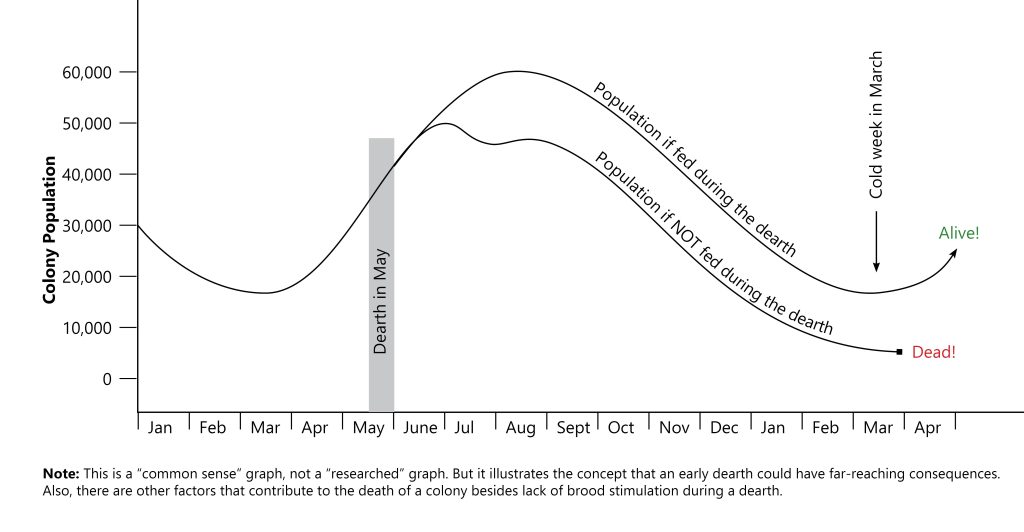
So how can the beekeeper ensure that there is a lot of young bees for the winter? That brings us to the third fundamental:
Brood rearing is all about stimulation and stimulation is all about nectar flow. If there is no natural nectar flow the beekeeper has to make one. Keep in mind: stored pollen and stored honey doesn’t do it. It has to be a flow. So, know your nectar flows. If you have a good queen, and there is room for her to lay, and there is a good nectar flow, it is guaranteed that she will be laying eggs. The more you can have her laying and keep her laying from the beginning of the season all the way through the season, the better your chance of winter survival will be.
Don’t let the queen shut down. True, you want her to shut down for winter, but from the time she starts laying in the spring till, the short, cool days in the fall when she needs to shut down, it is imperative that she is laying—all through the summer and into the fall. A shut-down queen in midseason impacts the health and strength of that colony in very subtle ways. For one, it is harder to restart her than to keep her going. But once the brood cycle stops, the population starts to dwindle. It’s like pushing a wagon uphill. Keep it moving and the motion is forward. Stop pushing and the motion will reverse and it is very difficult to get it going foward. A shut-down queen in summer is one of your worst enemies, especially for winter survival.
(The opposite of a nectar flow, of course) It’s what we have been talking about, but for clarity, we’ll give it as a fifth fundamental. Just like a shut-down queen, a dearth has subtle, negative, long range effects on a colony—another worst enemy. When there is no nectar flow for more than about a week and there is nothing soon to come, the colony goes into survival mode (necessary for the short term, but not a good for the long term). The queen shuts down to conserve resources. The honey that has already been stored begins to be consumed. And, of course brood stops. That is when you, the keeper of the bees, need to intervene. Don’t procrastinate. Don’t assume. Don’t hope everything will be all right. Time is of the essence. Get out and get connected.
Feed in May? For winter survival? Do what you got to do.
You must be logged in to post a comment.

Shawn Martin says:
Thanks for this important information! Seeing the graph you’ve included helped me visualize what you were expounding on.
One thing is certain, without a vision, the bees perish.