No products in the cart.
Several factors during the past two months have prevented a post. Not least was my own beekeeping, or rather, bee-losing experience. How could I advise beekeeping when my efforts to “keep” didn’t succeed?
I have written urgently in previous posts about the absolute necessity of beginning early to prepare for winter—to keep mites under control and to feed during all non-nectar flow periods to keep the queen brooding. I wrote with a ring of guarantee. “Do this and your bees will survive.” A sort of ticket to success.
But, my experience of the past two months has reminded me once again that our hobby (or business) of keeping bees is more a craft or art than a science. There is no 1-2-3 set of steps that can guarantee success. No checklist. No method or mechanical procedure. Rather, we are only necessary, yet small participants in the complex, unique, and wonderful, synergism of insects, weather, parasites, and disease—a dance or, shall we say a school, sometimes exhilarating and often disappointing. And so I do have a bit of advice from the school of hard knocks: learn and start again. It’s beekeeping and it’s life.
What happened? Mites were under control. Feeding was rigorous and, for a while, productive—nice, healthy brood. Everything was on track early and well for a good winter. What I missed was the early signs of European Foulbrood. I have not paid much attention to this disease over the past several years—almost forgot about it. But by all appearances, the healthy brood I thought I had, possessed the inoculation of trouble and did not possess the immunity to withstand the onslaught. While I thought I had success, the process of demise was already at work. Early detection of EFB is just as important as with Varroa. In fact, it seems that once it it visibly detected it’s a little too late.
I’ll come back to EFB in a later post. In the rest of this one I want to give some last-of-the-year pointers on feeding. But I’ll say this much: don’t take success for granted and add EFB to the list of challenges to be conquered early.
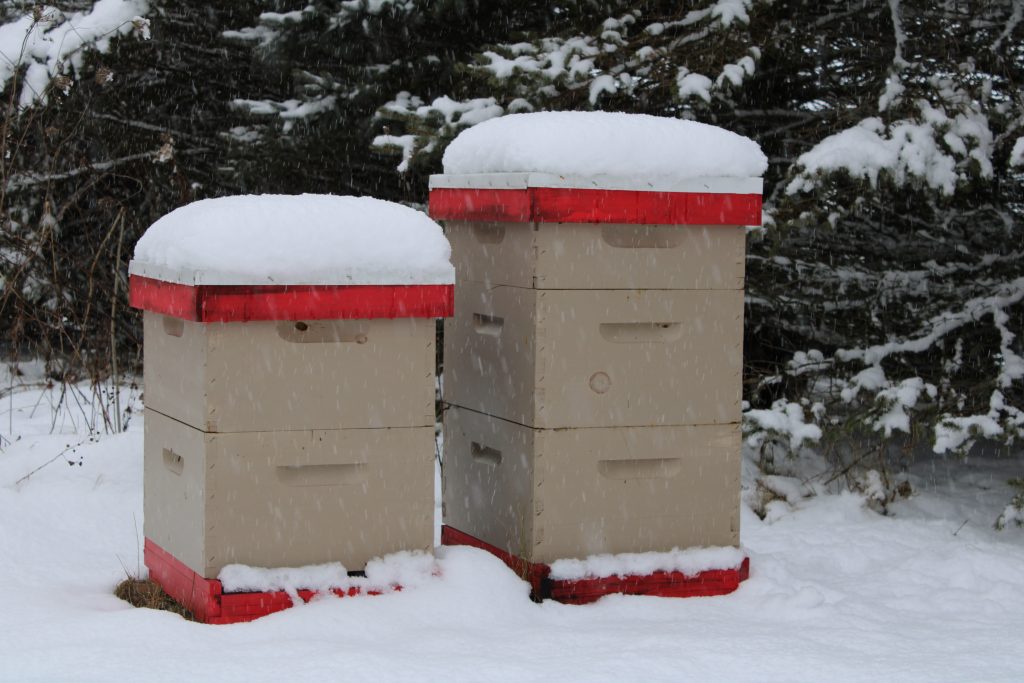
There are two main purposes for fall feeding. One, to keep egg laying stimulated with an artificial nectar flow so that there are a lot of new bees to go into the winter. And two, to develop a store of food for the winter.
For those of us in northern climates, our opportunity to feed for brood production is over. A few prolific queens might still be laying a few eggs, and, in most cases, there will be some capped brood to emerge yet. But, for all practical purposes, brood rearing is done for the season. That’s a good thing. It gives the queen a rest, breaks the brood cycle, and allows for other benefits of dormancy. But, if brood rearing ended in August, the chance of survival is slim indeed. There might be a lot of bees in that hive, but they are old bees—too old to survive the winter. By February or March, they will be dead on the bottom board. At this point, any chance of survival will depend on the chance that there was a late brood cycle or two as a result of a goldenrod or aster nectar flow, that the genetics of your hive is a small-cluster winterer, and that the winter is fairly mild. This is not a likely combination, but since hope is all that is left, then, of course, hope—and learn.
For sufficient winter stores, we still have a bit of a chance. While the feeding that you did through August, September and October may have translated into brood that will be adequate for successful overwintering, there may not be enough “stores” to keep it from starving. A good hive that has a basketball size cluster will need around eighty pounds of feed to see it through a five-month (more or less) winter. That’s two deep brood boxes pretty full of feed (honey or syrup). The hive will have a certain (heft) when lifted from the back of the hive. That “heft” is something you learn but eighty pounds lifted from the back and bottom of a hive on a regular hive stand is going to take some effort. If you “heft” it expecting it to be heavy and to take effort but instead the hive about “jumps” off the hive stand, it’s light! There isn’t enough feed in there to last the winter!
There are a few options.
1) Pull frames of feed from other hives that have more than they need. Or use frames of feed, full frames, that is, from dead-outs. No, using frames of feed from dead-outs won’t cause any problems.
2) If you have really good warm weather in late October and into November, you can feed a thick syrup (1/3 water to 2/3 sugar) with frame feeders or top feeders. It’s good to put some Honey-B-Healthy with the syrup and remember that they will be much slower to take it because temperatures drop at night and the bees go into cluster.
3) Most preferable, feed with one quart zip-loc bags. Yes, it works, but you must do several things to be successful. First, make sure the bags do not leak when zipped shut. Second, use a pin to prick at least half dozen holes in the one side. It won’t make a mess, but it will ooze out enough for bees to get it. And third, place the filled bag with pin pricks down, directly on top bars. Make sure the bees have access to some of the pricks in between the top bars. You will also need a spacer of some sort to accommodate the bag height. If hives are really light, place two on the hive. Do this as long as you need to to put on the weight that the colony needs. Bees will take that syrup even when they are in cluster. This method can be used to “weight up” hives well into the winter.
4) And then there are sugar bricks. These hard, square blocks can be put directly on top of top bars and the cluster of bees will migrate up to it, soften it with their heat, and consume it. You will need a three-inch spacer to accommodate the brick. Our winter chip boxes (more on that in a later post) have space for them built into them. Using sugar bricks is an emergency measure, but it is often good insurance, especially when there is a question about adequate food stores.
That’s it for now. I’ll attempt at least another post in December. And then will be the Bee Expo. Don’t miss our deals for that and we hope to see you there!
-Jonathan Showalter | Beeline of Michigan